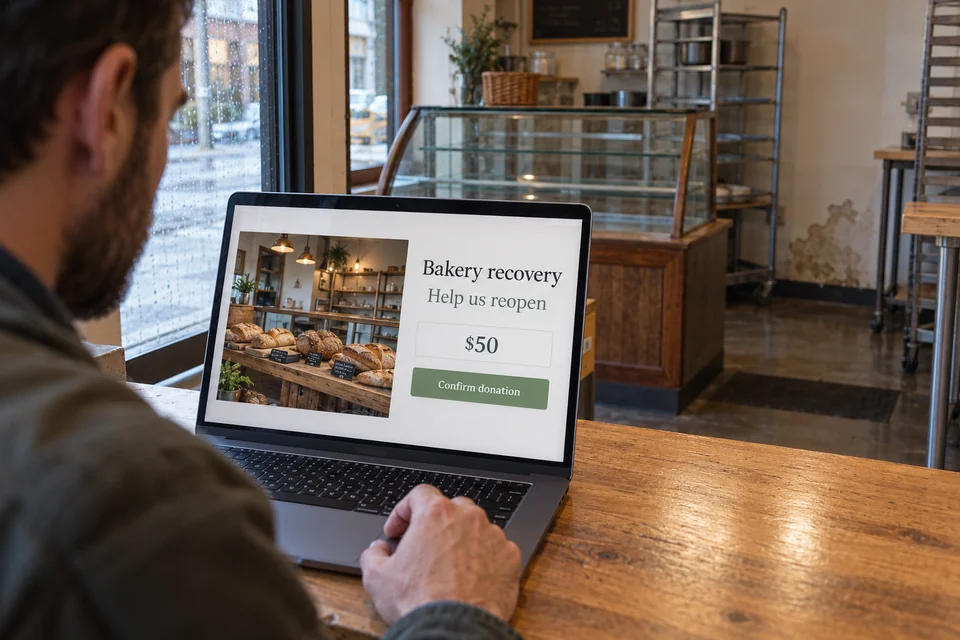
What business donation crowdfunding actually is
Business donation crowdfunding is an online appeal in which an owner, an employee or a friend of the firm invites people to give money so that trading can resume after something has gone badly wrong. Nobody who gives receives equity, interest or a discount voucher. The gift is voluntary, and the only thing the giver gets back is the satisfaction of having helped a business that matters to the neighbourhood.
That sets it apart from a loan, from an investment round and from a reward campaign, where backers are promised a product. A business recovery fundraiser sits closer to a collection tin on the counter than to a share issue, only with a much wider reach because a link can be passed around by email, text message and social media.
The format suits businesses that have a visible place in local life: a bakery, a family restaurant, a hairdresser, a repair garage, a market stall. People often know the owner by name, and that familiarity is what turns a sad story into a gift.
Emergencies that lead owners to ask for help
The typical triggers for a business donation appeal are events that interrupt trading suddenly and are expensive to put right. A kitchen fire, a burst pipe, a flooded cellar, a break-in, a vehicle crash that destroys a delivery van, a storm that tears off a shopfront: each leaves an owner with a damaged premises, spoiled stock and no takings while repairs go on.
Some appeals follow wider events, such as a flood that hits an entire high street or a local disaster that closes a district for weeks. In those cases several traders may share one campaign, which can look more credible than a string of separate pleas and spares donors from choosing between neighbours.
- Physical damage to premises, fittings or equipment
- Loss of perishable stock or tools
- Wages that still have to be paid while the doors are shut
- Gaps in insurance cover, or a claim that is slow to settle
A business donation appeal is usually strongest when the need is clear, recent and tied to an event people can picture.
Why customers give to a business fundraiser
Givers to a business fundraiser rarely think of themselves as philanthropists. They are regulars who miss the morning coffee, parents whose children had birthday cakes from the same counter, or suppliers who have traded with the owner for years. Their motive is loyalty and a wish to keep a familiar place on the street.
Employees matter too. When a firm closes, staff lose income at once, and an appeal that explains how many jobs depend on reopening tends to widen support beyond customers. Colleagues from the same trade sometimes give as well, because they know how thin the margins are.
A clear, honest account of what happened, backed by photographs of the damage, makes giving feel safe. Vague emotional language without any detail does the opposite.
Setting up a business recovery fundraiser
Start with the story told in plain words: what the firm does, what happened, when it happened, and what is needed to reopen. Add photographs of the damage and, if possible, an estimate or quotation from a builder, supplier or repairer. A target that can be traced to real costs convinces donors far better than a round number chosen at random.
Decide who will receive the money. Platforms normally pay out to a named bank account, and it helps to say openly whether that account belongs to the owner, to the company or to a trusted organiser. Where a person other than the owner runs the appeal, the owner should confirm it in writing and in public.
Then write a short spending plan in order of priority: safety repairs first, then equipment, then stock, then wages. Donors like to know that their gift will not disappear into unrelated debts.
Finally, choose a platform whose rules allow business purposes. General-purpose fundraising services such as GoFundMe and Crowdfunder in the United Kingdom publish their own terms on what they accept, and those terms change, so read the current version before you begin.
What donations to a firm are not
Donations to a business are not an investment. Donors acquire no ownership and have no claim on future profits, and a responsible appeal says so plainly. It is also not a loan, so nothing has to be repaid, although many owners choose to thank donors publicly once the doors reopen.
Tax treatment of donations to a business deserves care. Money received by a trading business can count as income for tax purposes, and the rules differ between countries and between legal forms such as sole trader, partnership and limited company. In the United Kingdom, HM Revenue and Customs explains how business receipts are taxed, and an accountant can say how a particular appeal would be treated.
Donors, for their part, should not expect a tax deduction. Gifts to a for-profit business are generally not eligible for charitable tax relief, which is aimed at registered charities and similar bodies. Anyone hoping for relief should ask the relevant tax authority before giving.
Other routes to recovery that run alongside an appeal
A business fundraiser should rarely be the only plan. Insurance is the first place to look: a business policy may cover fire, flood or theft, and the claim should be opened at once even if a donation campaign is under way. Owners should be honest in their story about any insurance payout so that donors are not left thinking the appeal covers costs that an insurer will pay.
Local councils, chambers of commerce and trade associations sometimes know of hardship schemes, relief funds or advice services after a major local event, and some set up community recovery funds of their own. Banks and specialist lenders may offer a repayment holiday or a recovery loan, which is a different product with its own risks and costs.
Seen this way, business donation crowdfunding fills the gap between what is insured or lent and what is actually needed, rather than replacing every other source of help.
Telling a genuine appeal from a scam
Emergencies attract fraudsters as well as supporters, and donations to a business are no exception. After a well-publicised fire or flood, copycat pages sometimes appear that borrow real photographs and name a business that never asked for help. Before giving, look for signs that the owner knows about the page: a link from the firm's official account, a notice at the premises, or a statement from the local newspaper.
Be wary of any business fundraiser that cannot say who receives the funds, that push you to pay by gift card or direct bank transfer outside the platform, or that rely entirely on emotion with no description of costs. Reputable platforms offer ways to report a suspicious page, and a report protects other donors too.
If the business is a registered company, its name can usually be checked on the national company register, which in the United Kingdom is Companies House.
Keeping faith with donors after the money arrives
A business recovery fundraiser does not end when the target is reached. Donors expect an update showing how the money was used, even a short one with a photograph of the repaired shopfront or the new oven. Regular posts during the rebuild keep supporters involved and discourage doubt.
If the sum collected falls short, say so and explain what will be done with it. If it exceeds the need, decide in advance whether the surplus will cover further repairs, be kept as a cushion or be passed to another good cause, and tell donors that choice before the appeal closes.
Honest accounting is what separates a firm that is remembered kindly from one that is resented, and it makes people far more willing to give again if trouble returns.
Frequently asked questions
Can a company run a donation campaign after a fire?
Yes, in most cases, provided the platform accepts business purposes and the appeal is honest about who receives the money. Owners should also check how received funds are taxed and tell donors that their gift is not an investment.
Do donors receive shares or repayment?
No. In donation-based appeals the giver receives no shares, interest or repayment. Campaigns that promise a financial return belong to investment or lending models, which carry different rules and risks.
Is a gift to a business tax deductible?
Usually not. Charitable tax relief is generally limited to registered charities and similar bodies, so gifts to a trading firm rarely qualify. Donors should ask their national tax authority before assuming otherwise.
How can I tell whether the owner knows about the page?
Look for a link from the firm's own official account, a notice at the premises or a local news report naming the page. If you cannot confirm it, contact the business directly before giving.