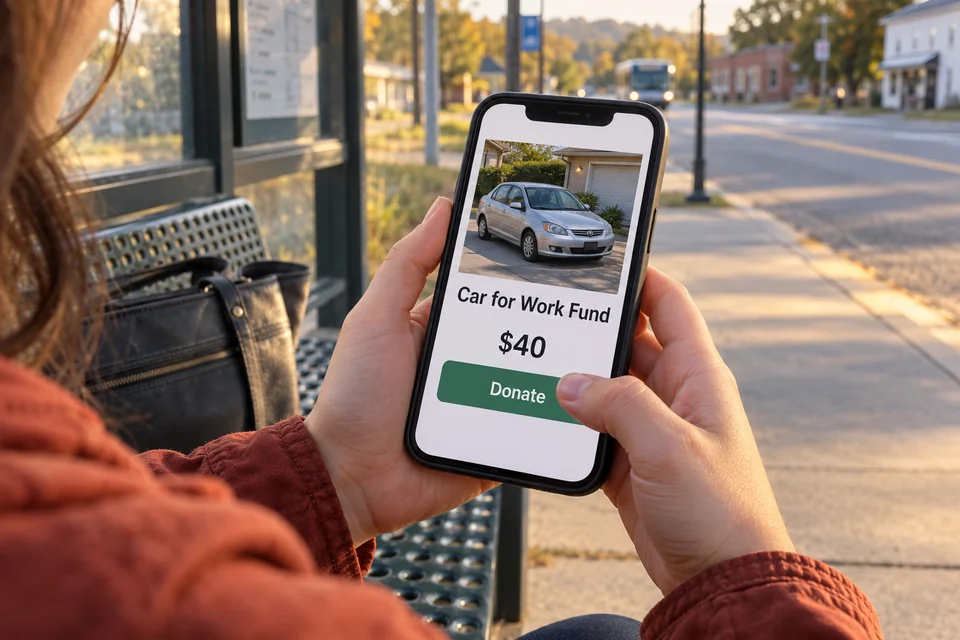
What crowdfunding for a car means
Crowdfunding for a car is the practice of turning a practical emergency into a public request. A household that has lost its only vehicle, or whose old one can no longer pass inspection, explains the situation online and invites friends and neighbours to contribute. Donors give as a gift, and nothing is expected back.
A car is not a luxury for everyone. Where public transport is thin, a vehicle may decide whether a parent can reach a night shift, whether a child can attend a specialist clinic, or whether an elderly relative can keep medical appointments. Supporters respond because they can see the knock-on effects of having no transport.
It is just as important to be clear about what such an appeal is not. It is not a way of financing a vehicle that donors would regard as a want and not a need, and it is not an investment. Appeals that are modest in scope and specific about the use of the vehicle are the ones that find sympathy.
Needs that make a car fundraiser convincing
A car fundraiser gains credibility when the vehicle is tied to something concrete. A parent who cares for a child with regular hospital visits, a care worker with early shifts and no bus service, or a rural family with no shops within walking distance can each explain a need that readers will grasp.
Another strong case is a vehicle lost through no fault of the owner, such as a theft, a flood, or an accident in which another driver was uninsured. A car fundraiser can then describe what happened and what has already been done, for instance a claim made or an insurer contacted.
Weaker cases are those where donors may suspect poor planning or where the vehicle is described as an upgrade. Appeals that avoid sensitive or exaggerated language, and that explain honestly why other options have been exhausted, are better received.
Writing an honest car fundraising page
Car fundraising pages should begin with the person and the problem: who needs transport, why, and what will change when the vehicle is in the driveway. A short paragraph about the daily routine that depends on the car is more convincing than a list of general hardships.
The cost should be described with care. A sensible approach is to look at the type of vehicle that would meet the need, such as a reliable used family car, and to explain the target in terms of a realistic purchase, together with the costs that follow the sale, such as insurance and registration.
- Say what happened to the previous vehicle, if there was one.
- Describe the journeys the car will make possible: work, school, treatment or care.
- Explain what the family can contribute itself, and what is being asked of donors.
Photographs of the family and of the situation help, provided everyone pictured has agreed to be shown. Privacy about medical details is worth keeping.
Budgeting beyond the purchase price
Owning a car involves more than buying it. Insurance, road tax or registration fees, an inspection test, fuel and ordinary servicing all follow. Car fundraising that covers only the price of the vehicle leaves the family struggling to keep it on the road.
Donors may also ask who will actually buy the car and how. An open answer, such as a purchase from a dealer or a private seller with a written receipt, makes people comfortable. Some organisers pay the seller directly, rather than receiving the donated money and buying later, to show that funds go to the stated purpose.
It is sensible to get the vehicle checked by an independent mechanic before buying. A donation that ends up paying for a car with hidden faults serves nobody, and a short report from a mechanic can be shared with supporters as evidence of care.
Legal and tax matters around car fundraising
Gifts received for a vehicle are generally not tax-deductible for the donor, because the money goes to a private individual and not to a registered charity. Treatment of the recipient depends on the country, so the national tax authority can confirm the position on crowdfunding for a car.
A family on means-tested support should ask the paying agency whether a fundraiser could change its entitlement. In some systems the value of a car, or money held for buying one, is taken into account.
Practical legal points also apply once the car is bought. The new owner must register it with the national vehicle authority, hold valid insurance and a driving licence, and pass any required inspection. Making these arrangements before the purchase avoids delay.
Looking at alternatives to car crowdfunding
Crowdfunding for a car is not always the best route. A family that can afford monthly payments may be better served by a loan from a bank, a credit union or a similar lender, with honest attention to the interest and the total cost. A loan is repaid, which a gift is not, so the two should never be confused.
For people with disabilities or long-term health needs, some countries run schemes that help with adapted or leased vehicles. In the United Kingdom, for instance, the Motability Scheme allows eligible people to use certain mobility allowances towards a car, and local councils and charities may give advice on transport support.
Local charities and community groups sometimes offer car-sharing, volunteer driving or small grants for essential travel. Mentioning these shows donors that the family has looked at other options before asking the public.
Sharing the appeal and building trust
The first gifts usually come from family, friends and colleagues. A personal message with the link, rather than a mass post, makes people feel asked and not pressured. An employer, a sports club or a parents' group may also agree to pass the appeal on to their members.
Visible honesty builds momentum. Donors like to see who has already given and what is still needed, and they like updates that show real progress: a mechanic's check, a short list of cars being considered, or the day the keys are handed over.
Repeated requests should be avoided. A single reminder after a week or two, and a thank-you after the target is reached, keep goodwill intact for the day when the family may need more help.
Spotting a fake car fundraiser
Fundraising for a necessary car is a common target for fraud. Warning signs include a vague story with no location, photographs that appear on unrelated websites, an organiser who cannot be reached, and a request to pay by voucher or cash transfer outside the platform.
Genuine organisers are usually happy to explain the plan and to show an estimate or quotation. A donor who asks politely where the money goes and receives an evasive answer should hesitate.
If an appeal seems false, it should be reported to the platform, and any payment already made should be raised with the card issuer. National consumer advice and fraud reporting services collect these reports.
After the keys: thanking donors and closing the campaign
Once the car has been bought, a final update should thank everyone and show the result. A photograph of the vehicle, shared with consent, lets donors see how their gifts made a difference to a family's daily life.
If more money arrived than the purchase required, the organiser should explain how the surplus will be used. Typical choices are insurance, servicing and tyres for the first year, or a donation to a related charity. Whatever is chosen should be stated openly.
Keeping receipts for the purchase and the other costs gives the family a record that can be shown to donors, an adviser or a tax authority if questions arise. A tidy close to the campaign leaves everyone with a positive memory.
Frequently asked questions
Is it acceptable to ask for donations for a car?
Yes, provided the need is real and explained honestly. Appeals for essential transport, such as for work, school or medical journeys, tend to be understood. Platforms have their own rules, so read them before publishing.
Do donors get tax relief?
Rarely. Money handed to someone for a vehicle counts as a personal gift, and deductions tend to be offered only for giving to registered charities. Practice varies by country, so a supporter in doubt can check with their own tax office.
Should car fundraising cover insurance and running costs?
It is wise to include the first costs after purchase, such as insurance, registration and a mechanic's check. A target that covers only the price may leave the family unable to keep the vehicle on the road.
Could a fundraiser affect my benefits?
It might in some systems, where savings or assets are counted when entitlement is assessed. Ask the agency that pays your benefit how gifts or a vehicle are treated before you launch an appeal.