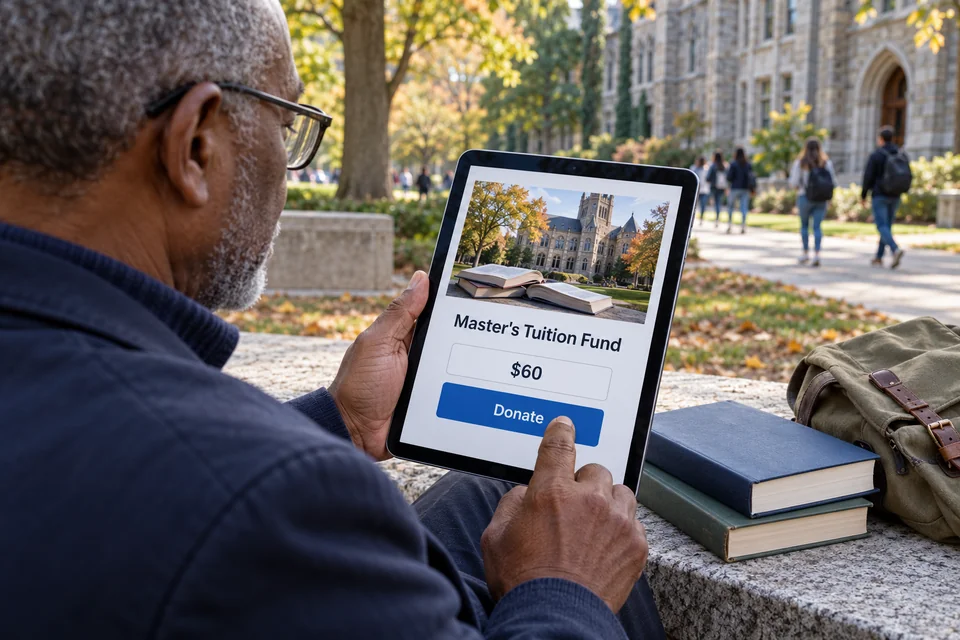
What education crowdfunding actually is
Education crowdfunding is a form of donation-based fundraising in which an individual, a parent group or a school publishes a campaign page explaining a learning-related need and invites supporters to contribute online. Nothing is owed back: a donor is giving a gift, not buying a stake or lending money.
Two broad kinds of campaign exist. Personal appeals are started by a student or a family member to meet the cost of a course, a laptop or a placement abroad. Institutional appeals are run by a school, a college, a parent-teacher association or a registered education charity to pay for a library, a minibus, a science kit or a hardship fund.
Both rely on the same basic ingredients: a clear purpose, a believable story, a sensible target and regular updates. What changes is the legal position behind the page, and that difference matters far more than most organisers realise.
Who starts a student fundraiser and why
The typical organiser is a postgraduate who has secured a place but not the money, a sixth-former facing an expensive trip required by a course, or a parent covering equipment that a school list demands. Mature students retraining after redundancy also turn to a student fundraiser or a wider education fundraiser when savings run short.
Others are teachers. A primary-school teacher might seek funds for reading corners or outdoor learning spaces, while a secondary department might want musical instruments or robotics parts. These appeals tend to be small, concrete and easy for supporters to picture.
Alumni and community groups play a part too. A former pupil may rally old classmates to refurbish a drama studio, and a village may pool gifts so a local school can keep an after-school club running.
Choosing between personal and school-run campaigns
A personal campaign is quick to set up and flexible, yet the money belongs to the organiser or the named beneficiary. Donors usually cannot reclaim tax on it, and the platform will often ask for proof that the funds reach the learner. Both types count as education crowdfunding, yet they sit on very different legal footings.
A campaign run by a registered charity or an established school body brings governance. Trustees oversee spending, accounts are filed with the regulator, and in the United Kingdom the charity may be able to claim Gift Aid on eligible gifts. Supporters tend to feel safer giving to such a structure.
- Ask whether the money is meant for one named person or for the whole school.
- Check who holds the bank account that receives the donations.
- Find out whether an existing charity or parent body can host the appeal.
If a school is involved, speak to the headteacher or the governors first. Many schools have rules about outside fundraising and about how gifts are recorded.
Writing a tuition fundraising page that earns trust
A convincing tuition fundraising page explains the course, the institution, the full cost and the amount already covered by the student's own effort. Naming the programme and the start date lets readers judge the request for themselves.
Break the target into pieces: fees, accommodation, books, equipment. Supporters respond better to a request for a defined item than to a vague plea for help, and the breakdown discourages questions about where the money will go.
Add a short, honest paragraph about what you have already tried, such as savings, part-time work, bursaries or scholarship applications. Then post updates when you receive an offer letter, pay a deposit or complete a term. Silence after the final donation is what damages a campaigner's reputation.
Money rules, tax and platform conditions
Rules differ by country and change over time, so organisers should check the current position with the relevant authority. In England and Wales the Charity Commission regulates charities, in Scotland the Scottish Charity Regulator does, and HM Revenue and Customs handles Gift Aid and tax questions.
A gift to an individual is generally personal money rather than a charitable donation, so there is no tax relief for the giver. Whether the recipient has any tax to consider depends on the circumstances, and a qualified adviser or the tax authority is the right place to ask.
General platforms such as GoFundMe and JustGiving publish their own conditions on permitted purposes, payment processing and withdrawals. Read them before launching, because a page that breaks the conditions can be paused while donors wait.
Crowdfunding next to loans, bursaries and scholarships
A student loan must be repaid under set terms, while a donation does not. That makes school fundraising attractive, but it also means income is uncertain: no one is obliged to give, and a target can fall short. That uncertainty is why education crowdfunding works best as one source among several.
Bursaries, scholarships and hardship funds from universities and charitable trusts are often a better first call. They are awarded against published criteria and can sit alongside a campaign. Many students combine a modest appeal with a grant rather than relying on public generosity for everything.
Where a gap remains after every other route, a small appeal for a specific item, such as a licence, a field trip or a set of instruments, is easier to complete than one for an entire degree.
Timing, sharing and thanking supporters
Term dates shape how a school fundraising drive performs. Appeals for equipment tend to land well at the start of an academic year, while fees campaigns need to finish before a payment deadline. Work backwards from that date and set a closing time that leaves room to collect any shortfall elsewhere.
Sharing is mostly personal. A direct message from the organiser to a relative or former teacher achieves more than a general post, and a short thank-you note for each gift builds the goodwill that carries a tuition fundraising page through its quieter weeks.
Once the campaign closes, tell supporters what was achieved: the course begun, the library shelves filled, the trip completed. Photographs of children or students should only be published with the necessary consent from parents or the learners themselves, and any surplus should be used as the page promised.
Keeping a school or student appeal safe from fraud
Education appeals attract imitators because the cause is sympathetic. Donors should look for a named organiser, a real institution that can be confirmed independently, and a clear purpose. A page that only offers emotional language and no verifiable detail deserves caution.
Organisers can protect themselves by keeping receipts, sharing evidence of fees paid and never asking supporters to send money outside the platform. Bank transfers to strangers, gift cards and requests for secret payments are classic warning signs.
Anything suspicious should be flagged with the fundraising platform and with the fraud-reporting body in your country; Action Fraud plays that role in the United Kingdom. Schools can also tell parents that genuine requests for money arrive through the school's own channels.
Frequently asked questions
Can I use crowdfunding to pay university tuition?
Yes, many students raise gifts towards fees, though a full degree is a large ask. Explain the course, show your own effort and break the target into items. Combine the appeal with bursaries or scholarships, since donations are never guaranteed.
Are donations to a student's campaign tax deductible?
In most cases no. Money given to one student is treated as a private present, which means the supporter gets no deduction. Giving to a registered charity or a school can sometimes attract relief, for example the UK scheme called Gift Aid, so check with the organiser or the tax office.
Can a school start its own online fundraiser?
Often, yes, but it should follow its governing body's rules. Many schools use a parent association or linked charity so that funds are recorded properly. Check the policy with the headteacher or governors before publishing any appeal.
How do donors know a student appeal is genuine?
Look for a named organiser, a verifiable school or course, an itemised target and regular updates. Be wary of pressure to pay by transfer, gift card or outside the platform, and report suspicious pages to the platform.