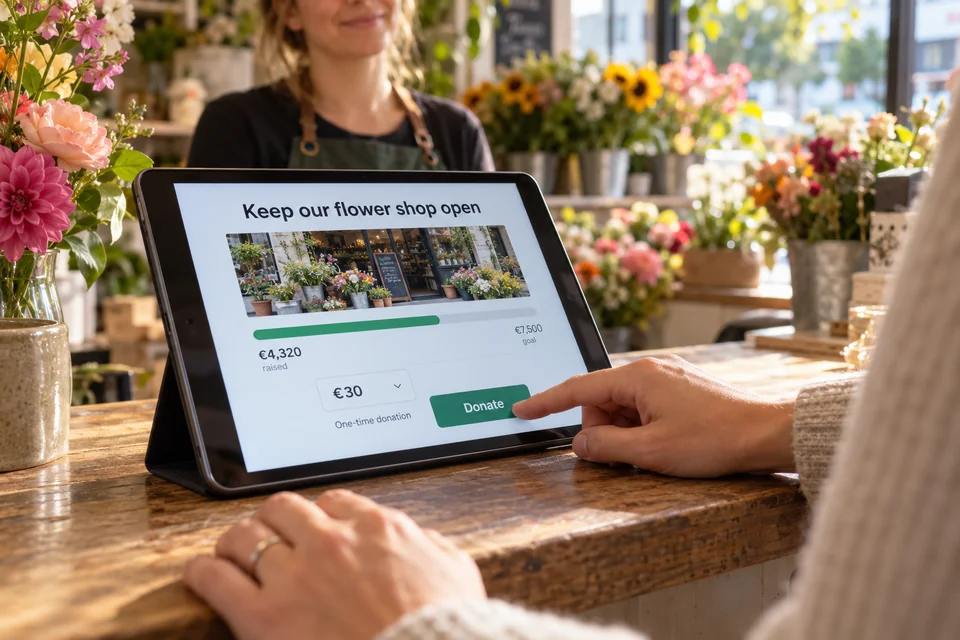
What crowdfunding for small business really means
Crowdfunding for small business by donation is an online appeal in which a trader describes a need, sets a target and invites people to give money as a gift. A donor receives no shares, no interest and no repayment. What the donor gets is the satisfaction of helping a business they value to carry on or to reach a particular goal.
That makes it quite different from a bank loan or an investment round. A lender looks at accounts and security; an investor looks at growth. A donor looks at the person behind the counter and at whether the story is believable. For that reason the people who give are, most often, existing customers, neighbours, relatives and followers who already know the trader.
Business crowdfunding by donation is therefore a tool for relationship-rich, small-scale ventures such as a bakery, a bicycle repair workshop, a bookshop or a market stall. It is rarely a good fit for a company whose appeal depends on anonymous strangers.
Why customers back small business fundraising
People give to a shop for reasons that have little to do with price. They want the street to keep its character, they remember a kindness, or they simply do not want a familiar face to disappear. A florist who knows which customer likes which stems, or a repairer who once rescued a broken heirloom, has goodwill that no advertisement can buy.
Timing matters as much as sentiment. A sudden event outside the trader's control, such as a flood in the premises, a stolen van or a long illness, gives supporters a clear and understandable moment to act. A vague wish to expand rarely produces the same warmth, because nobody feels an urgent reason to help.
Supporters also like to see a link between their gift and something visible afterwards, such as a repaired oven or a reopened door. Describing the outcome in concrete terms persuades more than describing the business in general terms.
Good reasons to ask, and weak ones
Some needs suit crowdfunding for small business naturally. Rebuilding after damage, replacing essential equipment that was lost or stolen, covering a short gap caused by an unexpected closure, or protecting a community space that locals rely on all give donors a story they can grasp in a sentence.
Other needs suit it poorly. Everyday running costs, old debts that have built up through weak planning, and plans to open a second branch are difficult to present as something a stranger should pay for. A donor may feel that the money is simply subsidising a business decision that ought to be financed in another way.
- Strong case: a clearly dated event, a defined cost and an outcome that can be seen.
- Weak case: an open-ended request with no deadline and no description of what changes.
- Risky case: a request that hides the fact that the business was already in difficulty.
Being straightforward protects the trader's reputation. A plain explanation of what happened and what the money will cover is better received than a polished but vague appeal.
Building a small business fundraising page people trust
A convincing page opens with a short statement of who the trader is, where the business operates and what it does. A clear photograph of the owner or the premises helps more than a stock image, since donors want proof that a real place exists. Then comes the need, written without exaggeration, followed by the goal and the date by which it matters.
Breaking the target into parts is helpful. Saying that a certain amount covers a replacement refrigerator and a smaller amount covers a month of insurance lets a supporter see where a small gift lands. The figures should be the trader's own quotes and invoices, and the trader should be ready to show them if asked.
Updates keep a campaign alive after the first burst of interest. Short posts that report progress and thank supporters show that the money is being handled seriously. Silence after a campaign closes is one of the quickest ways to lose the goodwill that made small business fundraising possible.
Thank-you gestures that do not become promises
Traders often want to say thanks with something tangible, such as a free coffee, a discount card or a named mention on the wall. When a gift is tied to a specific item in return, the arrangement starts to look like reward-based crowdfunding, which has its own expectations about delivery and its own platforms. Donation appeals work best when thanks stay informal.
If a small gesture is offered, it should be described as a gesture, not as a purchase. A handwritten note or a public thank-you carries no obligation and creates no complaint if circumstances change.
It is also wise to avoid anything that sounds like a share in profits or a future repayment. Words such as stake, return or investment push the appeal into the territory of regulated financial promotions, which a small trader is not prepared to handle and which donors would be right to question.
Money, accounts and tax questions
A gift to a person is not automatically a gift to a business, and the way money received is treated in the accounts can differ from what a trader assumes. Funds raised for a trading business may in some systems count as business income, while funds raised for a personal need may not. The answer depends on the country and the facts of the campaign.
Donors should not expect a tax deduction for giving to a commercial enterprise. Tax relief for gifts is normally reserved for registered charities and similar bodies, and a private company or sole trader does not usually qualify. Supporters who ask about this should be told plainly that no relief is expected.
The sensible step is to speak to an accountant before the appeal goes live and to read the guidance of the national tax authority, such as HMRC in the United Kingdom or the Internal Revenue Service in the United States. Rules on fundraising for a small business change, and a short conversation at the start avoids a difficult correction later.
Staying safe from scams and copycats
Small business fundraising in public attracts impostors. A common trick is to copy a genuine trader's story and photographs onto a new page that sends the money elsewhere. Owners can reduce the risk by publishing the appeal only through accounts they control.
Donors can protect themselves by checking that the story matches what the business says on its own channels, that the page names the person who receives the money, and that the platform in use offers some form of identity checking. A page that insists on payment by gift cards, cash transfer to a stranger or an unusual method deserves suspicion.
Anyone who has already sent money to a doubtful appeal should contact the payment provider promptly and report the page to the platform. Consumer protection bodies and national fraud reporting services exist for exactly this situation.
When business crowdfunding is the wrong tool
Donation crowdfunding is only one way to raise money, and often not the best for a business with a growth plan. A trader who wants to launch a new product may find that reward-based campaigns, where backers receive the product itself, match the situation more honestly.
A business that needs working capital, a vehicle or premises is normally looking at a loan, a lease or a grant. These routes involve repayment, credit checks and paperwork, but they do not depend on public sympathy. Government enterprise schemes and local business support organisations often publish guidance on grants and advice for new and existing traders.
The most useful question is what the money is for and who should reasonably carry that cost. If the answer is a community that values the business, a donation appeal may work. If the answer is the business itself, business crowdfunding is usually the wrong tool and other finance serves better.
Frequently asked questions
Can any trader use crowdfunding for small business?
Any business can try, but success depends on goodwill. Trusted local traders with a clear, sudden need and loyal customers do best. Platforms also set their own rules on commercial appeals, so read the terms of the chosen platform before publishing anything.
Do donors receive anything in return?
Not as of right. A donation is a gift, so there is no repayment, share or profit. A trader may offer a simple thank-you, but promising a product or a return changes the arrangement into reward-based or investment crowdfunding, with different obligations.
Is the money raised taxable?
It can be, depending on the country and on whether the gifts are treated as business income. Treatment varies, so ask an accountant and check the guidance of the national tax authority before starting any business crowdfunding appeal.
Can supporters claim tax relief for their gift?
Usually not. Relief on donations is normally limited to registered charities and comparable bodies, and a commercial business rarely qualifies. Donors should assume no deduction unless the tax authority confirms otherwise in writing.