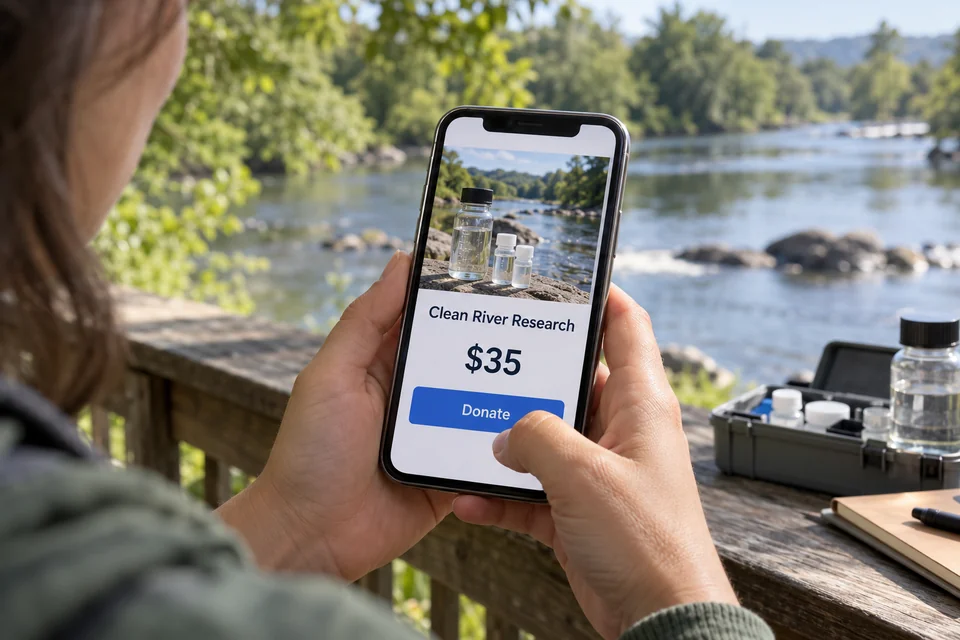
Research donation crowdfunding explained
Research donation crowdfunding is a way of paying for studies through many small voluntary gifts instead of a single grant. A scientist, a university team, a patient group or a charity describes a question, explains how it will be investigated and invites supporters to contribute. When the study succeeds, the benefit goes to the public in the form of knowledge, not to donors as profit.
This separates it from investing in a start-up, where backers hope for a share of future earnings, and from reward-based campaigns, where backers are promised a gadget or a book. A research fundraiser asks for belief in a question and in the people trying to answer it.
The appeal of the approach is easy to see. Traditional funders are selective, slow and often unwilling to back early ideas, so a modest public appeal can pay for a pilot, a piece of equipment or a field season that opens the way to bigger support.
Kinds of studies that attract donations for research
Donations for research in medicine have the clearest emotional pull, because many people have lived with a disease or lost someone to it. Patient groups and charities frequently raise money for studies on conditions that receive little attention elsewhere. Other fields draw support too: ecology and conservation, archaeology, astronomy, social science, education research and the study of local history.
Projects that suit public giving tend to have a clear question, a limited budget and a defined outcome. Examples include a survey of insect populations in a nature reserve, a pilot trial of a low-cost teaching method, or the digitisation of an archive that would otherwise decay.
- Early-stage ideas that need proof of concept
- Equipment, travel or fieldwork costs
- Studies on rare conditions or neglected topics
- Community science projects that involve volunteers
A science fundraising appeal is most convincing when its ask is specific and the work can reasonably be done with the money sought.
How donors can judge a study before giving
Supporters are not expected to be experts, but a few checks protect them. Who is behind the work? A named researcher attached to a university, hospital, institute or recognised charity is easier to verify than an anonymous page. Is there a credible track record, such as published papers or an earlier funded project?
Next, look at the plan. A sound appeal explains the question, the method, the timetable and how the money will be divided. It admits uncertainty. Language that promises a cure, a breakthrough or a guaranteed discovery should raise suspicion, because honest research cannot guarantee its outcome.
Ethics matter as well. Studies involving people, animals or sensitive data normally need approval from an ethics committee or equivalent body, and an appeal should say whether this has been obtained. Donors may also ask whether the findings will be shared openly or published in a journal, as that is how public benefit is realised.
Building a trustworthy research fundraiser
For researchers running a research fundraiser, the first step is clarity. Write for an intelligent reader who is not a specialist, avoid jargon and describe what difference the work could make. Explain why public funding is being sought, whether other funders have been approached and what the money will buy, in categories such as materials, travel and a research assistant.
Institutional support strengthens credibility. Many universities have a development or fundraising office, and some have policies on appeals made in their name. Using its channels can mean that funds are held by the institution and spent under its financial controls, which gives donors greater protection than payments to a personal account.
Be careful with promises. State what will be delivered, for instance a report, a dataset or a public talk, and when. Do not offer outcomes that depend on events beyond your control. A research donation appeal that sets realistic expectations tends to retain supporters if the work meets obstacles.
Charities, universities and platforms in the research landscape
Public donations have long been a major source of research funding through charities. In the United Kingdom, for example, Cancer Research UK funds studies largely through public giving, and the Association of Medical Research Charities represents many medical research charities. Giving to such organisations means that applications are generally assessed by expert reviewers before money is awarded.
Direct campaigns, including crowdfunding for public-benefit research, add a different route. Some universities run their own giving pages, and general platforms such as GoFundMe and Crowdfunder host research appeals. Specialist platforms for science, such as Experiment, focus on early-stage projects, each with its own rules on eligibility and fees that change from time to time.
Donors should understand the difference. A gift to a large research charity is pooled and directed by the charity, while a gift to a single project backs one team's idea. Both are legitimate; they simply carry different levels of risk and different kinds of oversight.
Tax, intellectual property and the use of results
Tax treatment of donations for research depends on who receives the gift. A donation to a registered charity or to a university's charitable arm may qualify for relief in some countries, for instance through Gift Aid in the United Kingdom, whereas a gift to an individual researcher usually does not. Donors seeking relief should ask the institution for confirmation and check with the tax authority.
For the researcher, money received may affect tax, grant terms and the rules of the employer. Many institutions require that outside funds pass through their accounts, and some funders restrict how projects may be financed. A quick conversation with the research office or finance team before launching avoids conflicts.
Intellectual property is a further question. Donors give for the public good, so researchers should explain who will own the results and whether they will be published openly. If a commercial partner might later use the findings, say so frankly.
Scams and misleading science appeals
Health and science are a rich field for unscrupulous campaigners, and a fake science fundraising appeal can look convincing. Warning signs include miracle-cure claims, appeals that cite impressive-sounding institutions without a link or contact, requests for payment outside the platform and refusal to name the researcher involved. Some research fundraiser pages promote an unproven treatment under the label of research, preying on people who are desperate.
A few minutes of checking go a long way. Search for the researcher's name and institution, look for a staff page or publication record, and see whether the institution itself mentions the project. Confirm whether the charity is registered by consulting the appropriate register, such as the Charity Commission in England and Wales.
If anything is unclear, write to the named person or the institution before giving. Genuine researchers are used to explaining their work and will usually be glad to reply.
Reporting back so that giving has meaning
The most valuable thing a researcher can do after a campaign is to tell supporters what happened, including when results are modest or negative. Science advances through failed experiments as well as successes, and donors who are told the truth often prove the most loyal.
Good updates are brief and concrete. They describe what was done with the funds, what was found, what remains uncertain and what the next step is. Link to any publication, preprint or public talk so that interested donors can read more, and thank them in terms that show their gift mattered.
In this way research donation crowdfunding builds a relationship between science and society, one that makes people more willing to support the next question worth asking.
Frequently asked questions
Do donors own any part of the research?
No. In donation-based appeals the giver receives no ownership, profit share or repayment. The benefit lies in the knowledge produced, which good projects try to share openly through publication or public talks.
How can I tell if a research appeal is genuine?
Check that the researcher is named and linked to a real institution, that the plan and budget are explained and that no cure is promised. Searching the institution's own website often confirms the project.
Is a gift to a research project tax deductible?
It depends who receives it. Gifts to registered charities or university charitable arms may qualify for relief in some countries, while gifts to an individual researcher usually do not. Ask the tax authority.
What happens if the study does not succeed?
Honest research cannot guarantee results. A responsible team reports what it learned, including negative findings, explains how the money was used and says what comes next, so that donors understand the outcome.