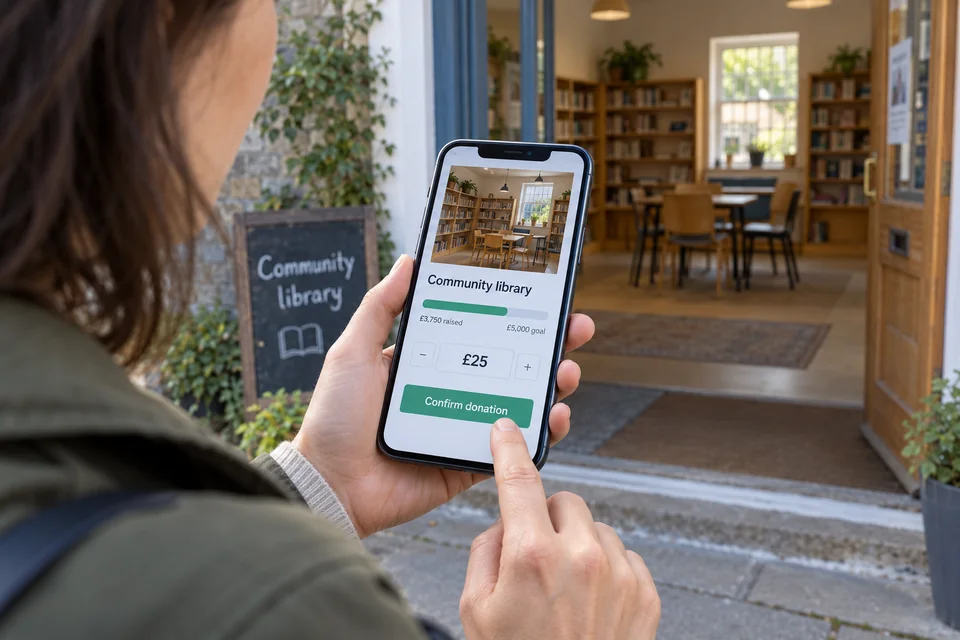
Community donation crowdfunding and the harambee tradition
Community donation crowdfunding happens when neighbours, former residents and well-wishers pay online towards a project that benefits a whole locality, and donors receive no financial return. In Kenya it has a deep cultural root: harambee, a Swahili word meaning pulling together, is the habit of gathering contributions for a school, a clinic, a funeral or a wedding, and it appears on the national coat of arms.
What changes online is reach and record. A traditional harambee meeting depends on who can attend, and contributions are often announced aloud and noted by a committee. A digital appeal lets Kenyans working in Nairobi, Mombasa or abroad pay at once from a phone, and each payment leaves an electronic trace that can be shown to everyone.
That trace is an asset for trust, because past community fundraising has sometimes been criticised when money went unaccounted for. Community donation crowdfunding can keep that accountability visible to every contributor, whether they live in the village or far away.
Choosing a project for Kenyan community fundraising
Projects that attract steady giving tend to be concrete. A community library with a reading room, a borehole for a village, desks for a primary school or a footbridge across a seasonal river each have a visible result, a defined cost and an obvious group of beneficiaries.
It helps to separate the capital need from running costs. Donors will give towards bookshelves and books more readily than towards an open-ended wage bill, and a project without a plan for upkeep may decline once the first excitement has passed. A good community project fundraising plan therefore explains who will look after the finished library, school block or water point.
Local knowledge matters. Committees that consult the area chief, the ward representative, teachers and elders before launching usually avoid duplication and resistance.
Timing deserves thought too. School terms, the planting and harvest seasons, and the weeks around major holidays all shape when households have spare money, so a community project fundraising calendar that respects those rhythms tends to collect more steadily than one launched at a difficult moment.
Registering the group that receives the funds
Kenyan law offers several routes for a group to gain legal identity. Community-based organisations are commonly registered at the sub-county social development office under the State Department responsible for social protection. Societies register with the Registrar of Societies, and non-governmental organisations with the NGOs Co-ordination Board. Trusts and companies limited by guarantee are other options for larger initiatives.
Registration gives a group a name that banks, platforms and donors can verify, and it allows the opening of an account in the organisation's own name instead of an official's personal account. Funds should never sit in private accounts, and an arrangement with two or three signatories reduces the risk of misuse. Without that structure, even a well-meant community donation crowdfunding drive can leave an official personally exposed when questions are asked.
Charitable organisations that want tax relief apply separately to the Kenya Revenue Authority, which decides whether income qualifies for exemption. Rules and procedures change, so the relevant offices should be asked for current requirements before an appeal starts.
M-Pesa and Paybill for donation crowdfunding in Kenya
Mobile money is the centre of Kenyan giving. M-Pesa, operated by Safaricom, lets people send money from a basic phone, and Airtel Money offers a similar service. Organisations commonly collect gifts through a Paybill or a Till number linked to their account, which gives each payment a reference and a timestamp.
Several platforms support online appeals for Kenyan projects. M-Changa is a Kenyan platform built around mobile money and widely used for medical, education and community appeals, and international services such as GoFundMe are also available to organisers who can use cards. Each has terms on withdrawals, verification and service charges that should be read before launching.
The Central Bank of Kenya supervises payment service providers under the National Payment System Act, so a platform that moves donors' money should use regulated channels.
Smaller gifts matter in this setting. Many supporters can afford only a modest sum, and mobile money makes small contributions practical for the first time, so a page that welcomes every amount and thanks each giver by name or by number builds a wide base instead of relying on a handful of wealthy backers.
Openness, records and donor data
People will give again to a committee that shows its books. Publish the total received, list major costs as they are paid and share photographs or short reports from the project site. Plain language and regular updates through community meetings, church notices, WhatsApp groups and the campaign page itself reach different audiences. That habit turns a one-off harambee into a lasting model of Kenyan community fundraising.
Keep names of contributors with their consent, and think about whether publishing amounts beside names is appropriate. Kenya's Data Protection Act of 2019 sets rules for handling personal data, and the Office of the Data Protection Commissioner supervises compliance. Phone numbers that appear in payment records should not be passed to third parties or used for unrelated marketing.
A short written agreement among committee members, setting out who approves spending, helps settle disagreements before they become public disputes.
Public fundraising rules and political sensitivities
Fundraising in Kenya has a political dimension, because harambees have at times been attached to election campaigns and public office. Parliament has debated bills to regulate public fundraising appeals, and the content of such proposals has been disputed. Organisers should therefore ask the relevant authorities, including the county government and the registrar that supervises their group, for the position that applies on the day they begin.
A community appeal that stays apolitical, names its beneficiaries and keeps public officials out of the handling of money is on the safest ground. If a public figure offers a donation, it can be accepted openly like any other gift and recorded in the same way.
Local permissions may be needed for physical events, such as a fundraising dinner or a public meeting, which are separate from the online appeal.
Avoiding fraud and keeping supporters safe
Fake appeals use real photographs, urgent language and a personal mobile number. Donors can reduce risk by checking that the group is registered, asking who holds the account and preferring a Paybill or Till number registered in an organisation's name. A request to send money to a personal number to unlock a larger prize or loan is not a genuine charity request.
Offences such as online impersonation and fraud are addressed in the Computer Misuse and Cybercrimes Act of 2018, and the Directorate of Criminal Investigations has a cybercrime unit that takes reports. Platforms also have reporting buttons and can pause withdrawals if a campaign looks suspicious.
Organisers should warn supporters about fake copies of their campaign, since copycat pages often appear when a real one starts to attract attention.
Finally, keep communication honest about what a campaign can achieve. If the target is not met, say so, explain which part of the project will be built first and invite supporters to decide whether to continue, wait or redirect the money.
Frequently asked questions
Does a Kenyan community group have to be registered to fundraise online?
A registered group is easier to trust and can hold an account in its own name. Routes include community-based organisation registration, societies and NGOs. Ask the relevant office what applies to your project, because requirements change.
Can I collect donations through M-Pesa for a community project?
Yes, groups usually use a Paybill or Till number linked to an organisational account. This records each payment and is safer than a personal number. Check Safaricom's current conditions for opening one.
How do I show donors that money was spent properly?
Publish totals received and costs paid, keep receipts, and share photographs or short reports from the project. Regular updates through the campaign page and community meetings show that the committee has nothing to hide.
Are donations to a community project tax-deductible?
Not automatically. Whether a gift qualifies for relief turns on who receives it and on current Kenya Revenue Authority rules, which are subject to change. Before assuming that a given organisation and gift are covered, put the question to a tax adviser or to the Kenya Revenue Authority.